What Would Make Stepper Motor to Stop Working
By Nippon Pulse America
Have you ever picked up a motor and discovered it had a few more wires then you lot were expecting? If and then, it was probable a footstep motor. Step motors are normally used in a number of products, from wrist watches to printers, Iv pumps to gas pumps. They are also found in machine tools, process command systems, record and disk bulldoze systems, and programmable controllers.

Common permanent-magnet (PM) step motors are the Can Can or claw-tooth type. They operate on the reaction betwixt a permanent-magnet rotor and an electromagnetic field.
As common equally stride motors are, however, there is much defoliation about the differences between Unipolar and Bipolar step motors, and how Constant Electric current and Constant Voltage pace motor drives piece of work.
This 2-office series volition cover the virtually important steps of troubleshooting any step motor system. It will include an overview of step motors — what they are and how they work, and how to troubleshoot them. The second article will too encompass the electronics needed to make a step motor run, and provide more information on troubleshooting.
The basics
A step or stepping motor converts electronic pulses into mechanical movement. Each electronic pulse "pace" causes the shaft to rotate a certain number of degrees (step angle). Thus, a step motor can operate in an open up loop application where it will movement a certain distance at a certain speed without the demand for feedback.
The step motor tin maintain the holding torque indefinitely when the rotor is stopped without called-for up the motor windings. When a step motor has a steady dc bespeak applied to one stator winding, the rotor will overcome the residue torque and line up with that stator field. The holding torque is the amount of torque required to move the rotor ane full step with the stator energized.

A stride motor converts electronic pulses into mechanical movement. Each pulse "step" causes the shaft to rotate a certain number of degrees (step angle), enabling open up loop operation.
When no power is applied to the windings, a small magnetic strength develops between the permanent magnet and the stator. This magnetic forcefulness is called the balance, or detent torque. Information technology can be noticed past turning a step motor by manus and is generally most one-tenth of the property torque.
In a typical one-stage stride sequence for a two phase motor, phase A of a two-phase stator is energized (Step 1). This magnetically locks the rotor in the position shown, because unlike poles attract. When stage A is turned off and phase B is turned on, the rotor rotates ninety° clockwise. In Step 3, phase B is turned off and stage A is turned on but with the polarity reversed from Step 1. This causes another 90° rotation. In Step four, stage A is turned off and phase B is turned on, with polarity reversed from Footstep 2. Repeating this sequence causes the rotor to rotate clockwise in ninety° steps.

Here is a typical pace sequence for a two stage motor.
In that location are three primary types of step motors: permanent-magnet (PM), variable reluctance (VR) and hybrid.
The permanent-magnet (PM) footstep motor operates on the reaction between a permanent-magnet rotor and an electromagnetic field. I of the most common PM motors are the Tin Can or claw-tooth type. In tin tin can steppers, the rotor shaft is surrounded past a magnet with radially opposing poles. It has no teeth. The stator is a series of poles with wound wire coils. Considering of the magnet, the rotor volition resist movement fifty-fifty when the motor is not energized.
Permanent magnet step motors are used in low-price, low-power applications. The bill feeder inside vending machines is driven by a permanent magnet footstep motor.
The variable-reluctance (VR) step motor differs from the PM stepper in that it has no permanent-magnet rotor and no residual torque to agree the rotor at i position when turned off. This type of motor operates on the principle of minimizing the reluctance along the path of the applied magnetic field. 1 of the first uses for variable-reluctance stride motors was to move the direction indicator of torpedo tubes and guns on British warships in the 1920's. Shortly thereafter, they were used by the The states Navy for a like purpose.
The hybrid step motor consists of ii pieces of soft fe, as well every bit an axially magnetized, round rotor. It'southward called a hybrid because the motor operates nether the combined principles of the permanent magnet and variable-reluctance step motors.
The stator core structure of a hybrid motor is essentially the same every bit its VR counterpart. The chief difference is that in the VR motor, merely one of the two coils of i phase is wound on one pole, while a typical hybrid motor will take coils of 2 different phases wound on the same pole.

In this cantankerous section of a ii-stage hybrid motor, each pole is covered with uniformly spaced teeth that are misaligned with each other by a half-tooth pitch. The interaction of the magnetic field of the permanent magnet and the magnetic field produced by the stator create torque.
The two coils at a pole are wound in a configuration known as a bifilar connection. Each pole of a hybrid motor is covered with uniformly spaced teeth made of soft steel. The teeth on the two sections of each pole are misaligned with each other by a one-half-tooth pitch. Torque is created in the hybrid motor by the interaction of the magnetic field of the permanent magnet and the magnetic field produced by the stator. Almost hybrid steppers are NEMA size motors. The windings for steppers come up in 2 types: Bipolar and Unipolar. In that location are a number of advantages to each type of winding.
The two-stage stepping sequence described earlier uses a "bipolar coil winding." Each stage consists of a single winding. It is referred to as a bipolar winding because the current flow on the coils is reversed. By reversing the electric current in the windings, electromagnetic polarity is reversed.
The unipolar winding is sometimes chosen a iv-phase stepper. It consists of 2 windings on a pole continued in such a way that when one winding is energized a magnetic north pole is created; when the other winding is energized, a south pole is created. It is referred to every bit a unipolar because the electric polarity, or electric current flow, from the drive to the coils is never reversed.
What can go wrong with step motors
In full general, at that place are four things that can go incorrect with a motor: They burn upwardly, the brushes go bad, the bearings go bad, or a technician breaks them.
They fire up. An important characteristic of the pace motor is that it can maintain the holding torque indefinitely when the rotor is stopped. If a step motor stalls out, it is unlikely that information technology will burn up as with about ac and dc motors. If the motor does burn upward it indicates a driver problem. (We will explore why this is the case in the next article.) Just replacing the motor will cause the motor to burn up again. This is not a mutual problem with stride motors unless there is a bad driver.

Case of a bipolar winding and example of a unipolar winding. In a bipolar winding the current flow on the coils is reversed, which reverses electromagnetic polarity. In a unipolar winding, the electric polarity, or current flow, is never reversed, hence the name unipolar.
The brushes go bad. In that location are no brushes in a stepper motor. Therefore, this volition never be a crusade of failure.
The bearings go bad. The libation the motor stays, the longer the bearings will last. At times, notwithstanding, the bearings volition get bad. Nevertheless, this is not a common problem. The bearings in nearly inexpensive motors are rated at 3000 hours or more, and most high-stop quality motors are rated at ninety,000 to 100,000 hours.
The technician breaks them. This is the near mutual cause of failure for stride motors. When working with these devices, exist careful with them. They do non demand to exist handled like fine china but don't attempt to ready one with a hammer. Most cheap motors use glue to hold the shaft to the rotor, and most quality steppers will use grooving along with adhesive.
To test the motor, start utilize an ohmmeter. Information technology will indicate if a winding is burnt upwardly and what type of step motor yous accept, usually a bipolar or unipolar.
A bipolar volition always accept four leads. A unipolar volition have five or half dozen leads. If five leads, the ii common wires are connected. A few motors will take viii leads; these motors can be wired as either unipolar or bipolar.
Using the ohmmeter, cheque the resistance of the windings. On a bipolar the resistance for both windings should be the aforementioned in both directions. In a unipolar winding, the resistance from each phase to com should be the same in both directions. After y'all accept checked the motor with the ohmmeter, you can utilize a 9V battery to step the motor through its paces. This will confirm the motor windings are good. You tin use the charts in Figure 9 for assistance.
You tin turn the motor by hand while listening for bad bearings. All PM and hybrid footstep motors will have some detent torque. PM volition have more than the hybrid steppers. If the leads of the step motor are touching, the detent torque will be greatly exaggerated. Be careful! Some technicians take falsely linked this to bad bearings. If the bearings are bad, there will usually be extra axial play in the motor. If possible, check against a known good motor.
When replacing a motor, many wonder about the color code for the wires. Remember the windings make up an electromagnet. As long every bit you accept the windings grouped correctly (Phase i and 3 together and Stage 2 and iv together) the worst that will happen when yous go to run the motor is that it volition run backwards. To correct, just bandy one ready of phases (1 and 3 or 2 and 4).
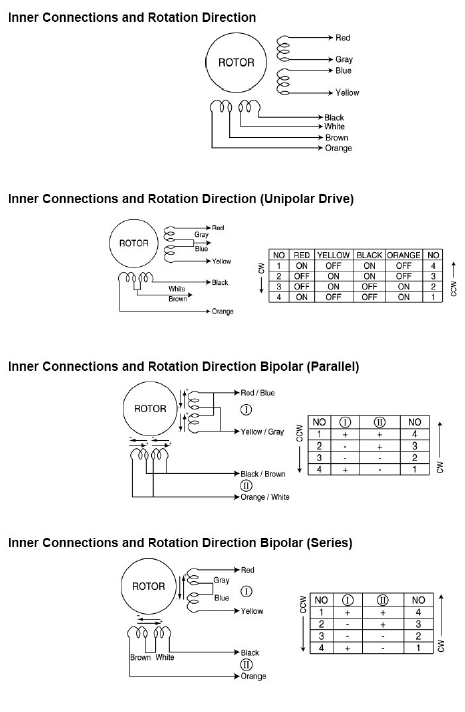
A few step motors volition have eight leads; these motors tin can exist wired as either unipolar or bipolar.
Next time we volition explore the differences between Bipolar vs. Unipolar windings and how Constant Current and Constant Voltage types of stepper motor drives work. And respond the question, why practise I use a 5V motor when I have a 24V supply? DW
Nippon Pulse America
www.nipponpulse.com
You may also like:
Filed Under: Motion command • motor controls, Motors • stepper
Source: https://www.designworldonline.com/step-motorstroubleshooting-basics-part-1/
0 Response to "What Would Make Stepper Motor to Stop Working"
Post a Comment